Abstract
Geometric optimization, not model expressiveness, is the bottleneck
Flow matching learns vector fields by regressing stochastic velocity targets along intermediate
distributions \(p_t\). We identify a geometric optimization bottleneck in this
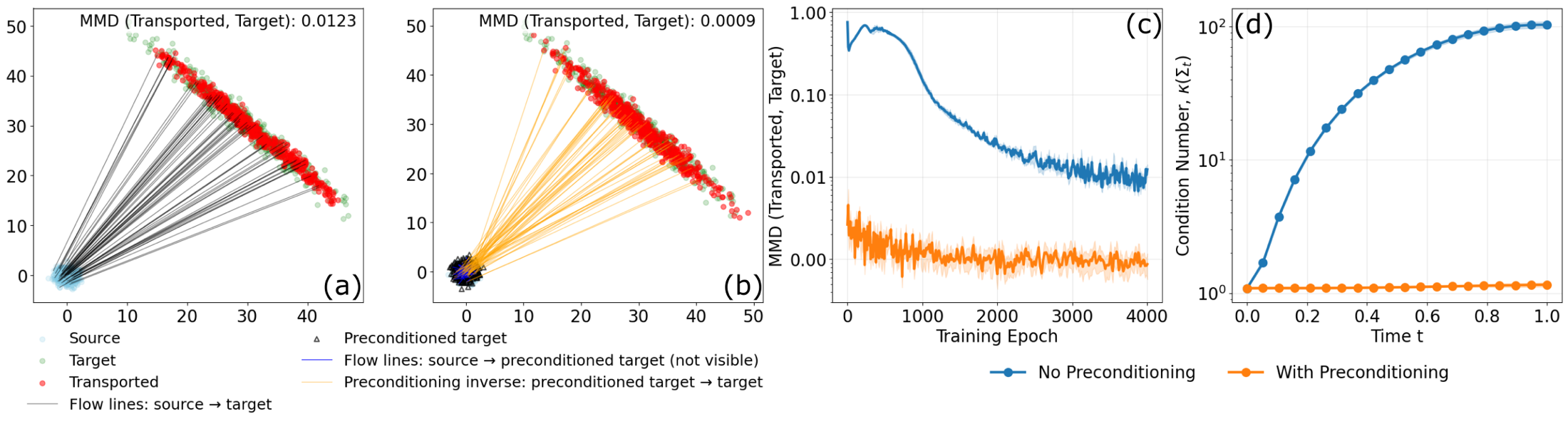
regression problem: when the covariance \(\Sigma_t\) of \(p_t\) is
ill-conditioned, gradient-based training rapidly fits high-variance directions while making slow
progress along low-variance ones.
In an exactly solvable Gaussian setting, we prove that the excess risk is weighted by
\(\Sigma_t\), and that both gradient descent and stochastic gradient descent inherit
condition-number-dependent convergence. We then extend the analysis to Gaussian mixtures, showing
that multimodality does not average away this effect; instead, the slowest and worst-conditioned
component can control optimization.
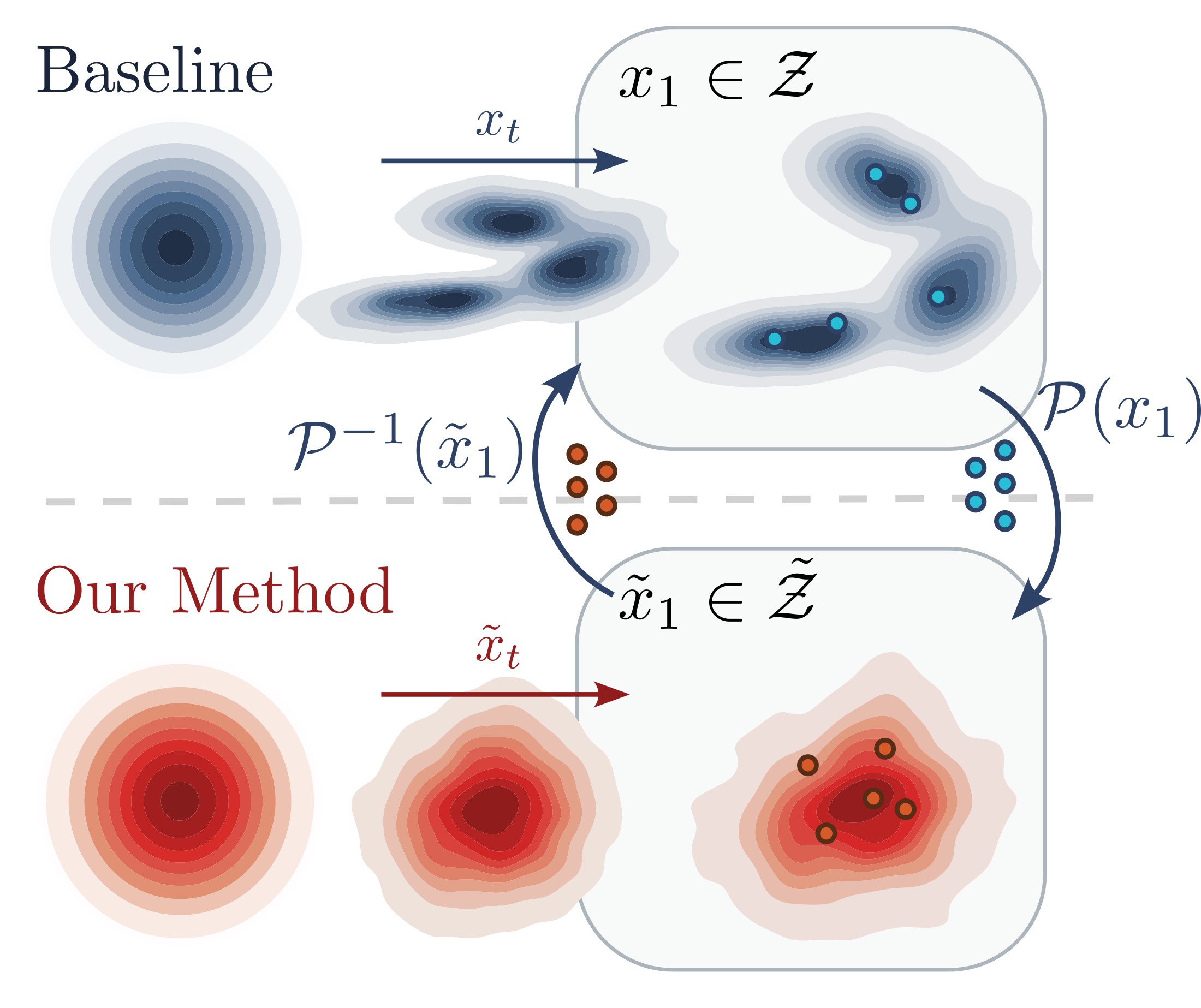
Motivated by this analysis, we propose preconditioned flow matching, a
precondition-then-match framework that transforms the target distribution into a more isotropic
representation, trains the main flow in the transformed space, and maps generated samples back
through the inverse transformation. We show theoretically that preconditioning reshapes the
intermediate FM path and improves its conditioning. Across controlled Gaussian and Gaussian-mixture
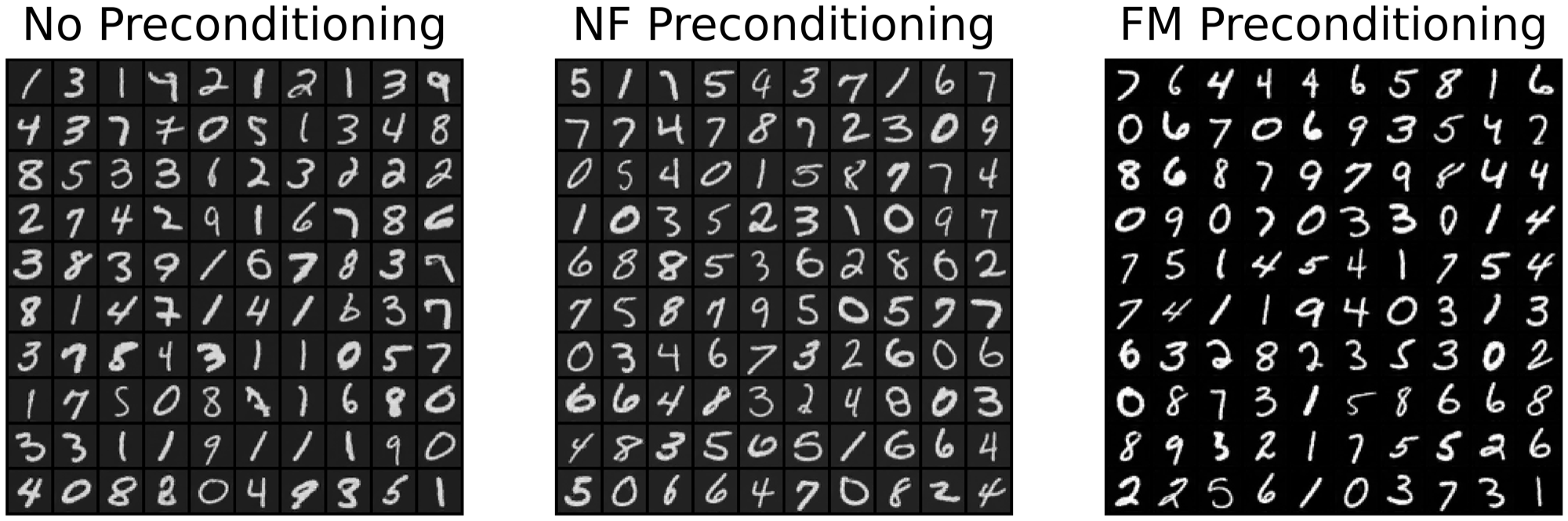
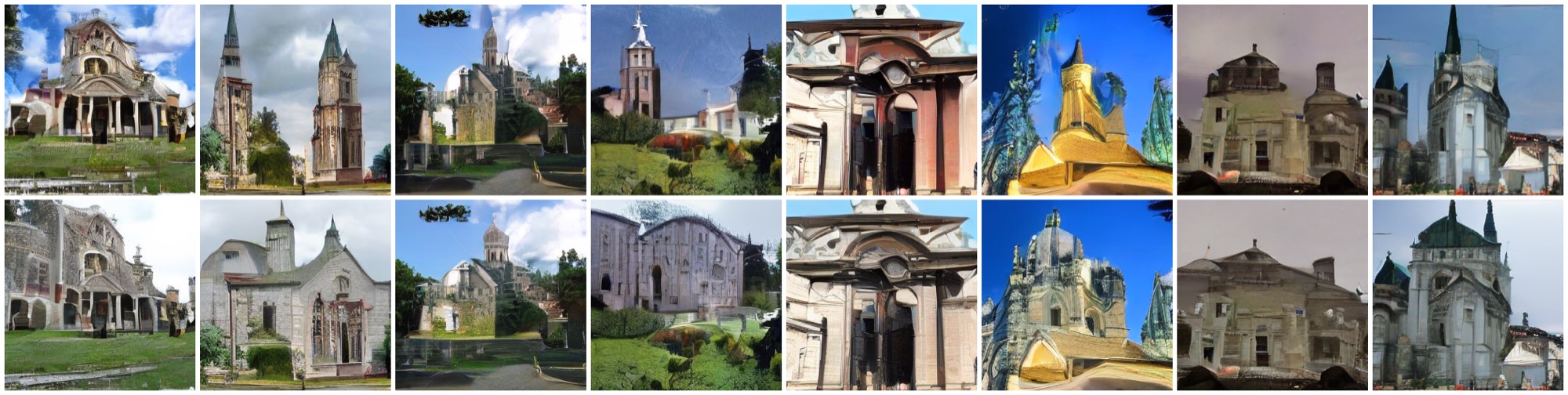
experiments, latent MNIST and other high-resolution image datasets up to 512×512, preconditioning
improves path-conditioning diagnostics, low-eigenvalue recovery, FID, MMD, precision and recall.
Compute-matched baselines and preconditioner-quality ablations further show that the gains are not
explained merely by additional preconditioner parameters, but by improved geometry of the downstream
flow matching problem.